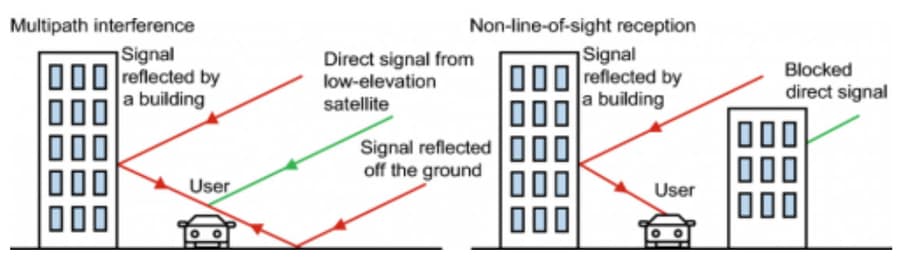
Researchers have introduced an innovative Artificial Intelligence (AI) solution aimed at improving the accuracy of Global Navigation Satellite Systems (GNSS) in urban settings by addressing Non-Line-of-Sight (NLOS) errors. The Light Gradient Boosting Machine (LightGBM) based method, developed by a team from Wuhan University, Southeast University, and Baidu, analyzes multiple GNSS signal features to distinguish between Line-of-Sight (LOS) and NLOS signals with 92% accuracy.
This advancement is crucial for the development of smart cities and transportation networks, where precise positioning is essential. Urban environments, with their tall buildings and other obstructions, have traditionally posed significant challenges for GNSS technology, leading to inaccuracies that affect autonomous vehicles and intelligent transportation systems.
The research, published in Satellite Navigation, demonstrates that excluding NLOS signals from GNSS solutions can markedly improve positioning accuracy. The LightGBM model outperforms traditional methods like XGBoost in both accuracy and computational efficiency, offering a promising solution to a long-standing problem in urban navigation.
Dr. Xiaohong Zhang, the lead researcher, highlighted the potential impact of this breakthrough on applications such as autonomous driving and smart city infrastructure. The ability to accurately identify and exclude NLOS errors could revolutionize urban navigation, making it safer and more reliable for a wide range of technologies and services.
Supported by funding from the National Science Fund for Distinguished Young Scholars of China and other sources, this research represents a significant step forward in the integration of AI with GNSS technology. As cities continue to evolve into smarter, more connected environments, the demand for precise and reliable navigation systems will only increase, making this development timely and highly relevant.
The implications of this AI-powered GNSS error identification system extend beyond navigation, offering potential benefits for urban planning, autonomous vehicle deployment, and the overall efficiency of smart city infrastructures. This breakthrough could pave the way for the next generation of transportation and navigation technologies, marking a milestone in the journey towards more intelligent and connected urban environments.