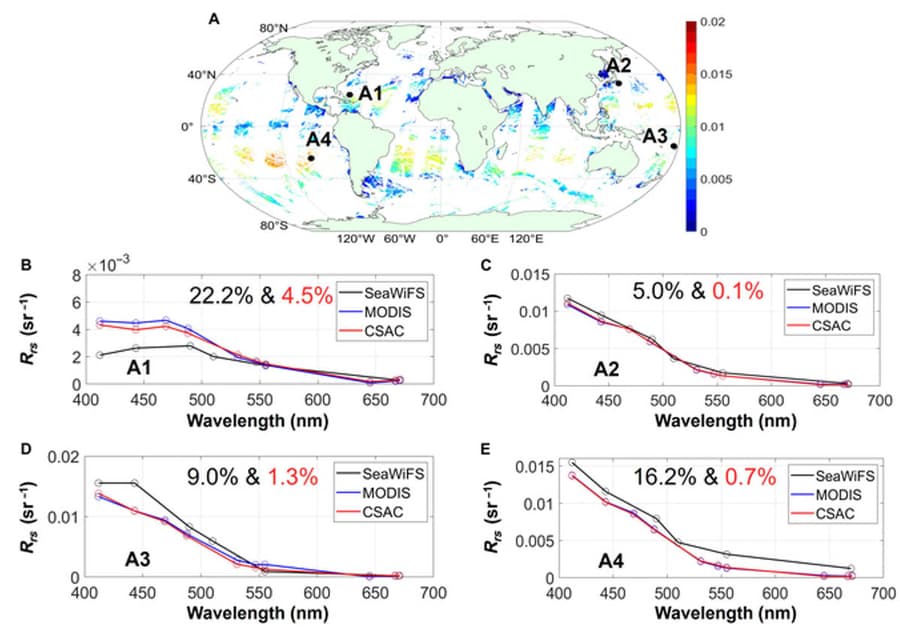
The introduction of the Cross-Satellite Atmospheric Correction (CSAC) system by researchers at Xiamen University and the National Satellite Ocean Application Service marks a significant advancement in satellite ocean color data harmonization. Published in the Journal of Remote Sensing on November 7, 2024, this innovative approach utilizes artificial intelligence to align top-of-atmosphere reflectance data from multiple satellites with a standardized remote sensing reflectance database, derived from over 20 years of high-quality MODIS-Aqua observations.
Traditional methods of atmospheric correction have been hampered by sensor-specific algorithms, leading to inconsistencies in data from different satellite missions. CSAC addresses these challenges head-on, demonstrating a reduction in discrepancies across wavelengths and achieving up to a 50% decrease in mean absolute percentage differences compared to conventional techniques. This leap in data consistency is pivotal for the creation of long-term datasets essential for monitoring the impacts of climate change on marine ecosystems.
Dr. Zhongping Lee, a lead researcher on the study, highlights the transformative potential of CSAC. By integrating decades of MODIS-Aqua data with advanced machine learning, CSAC not only enhances data reliability but also enables the scientific community to compile accurate, long-term records of ocean bio-optical properties. These records are indispensable for climate research, offering insights into the ocean's role in the carbon cycle and the effects of global warming on marine biodiversity.
The implications of CSAC extend beyond improved data processing. Its AI-driven methodology represents a paradigm shift from radiative-transfer-based to data-based systems, setting a new benchmark for future satellite data analysis. This innovation is timely, as the need for precise, consistent ocean monitoring grows amidst escalating climate change threats. CSAC's ability to generate reliable, long-term datasets from multiple satellite missions will be instrumental in guiding ocean conservation efforts and climate mitigation strategies.
Supported by the National Natural Science Foundation of China and other entities, the development of CSAC underscores the value of international collaboration in advancing Earth observation technologies. As the global scientific community adopts this groundbreaking system, CSAC is poised to significantly enhance our understanding of ocean dynamics, marine ecosystem health, and the overarching impacts of climate change on the planet's most critical resource.