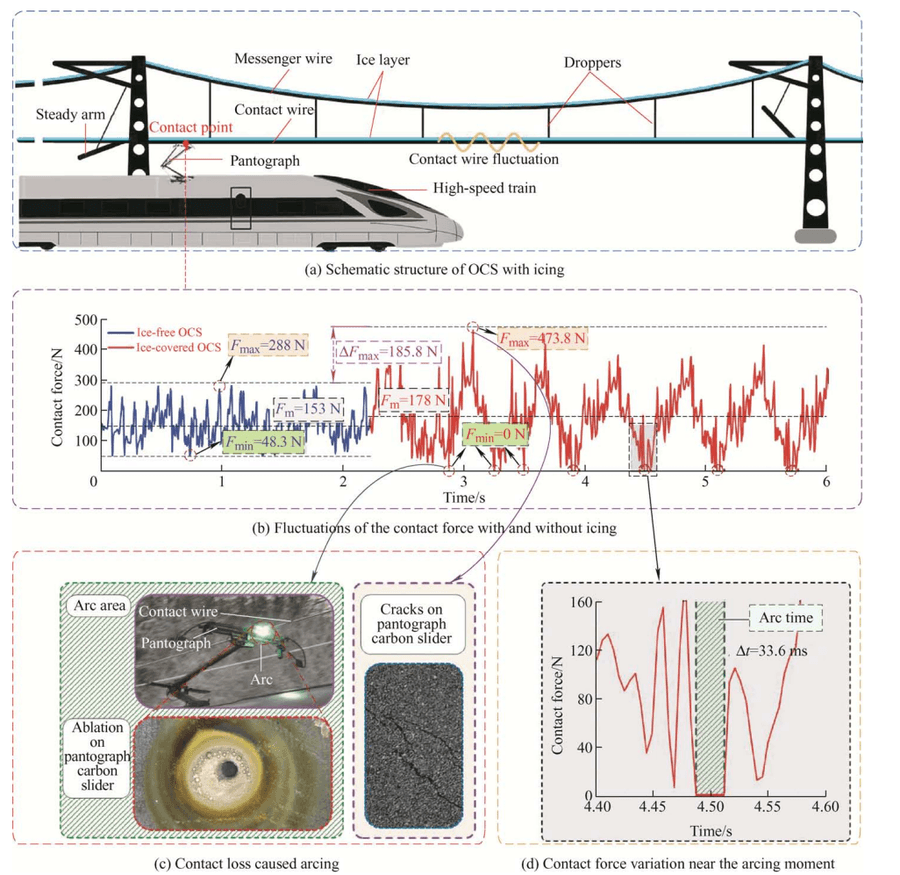
A recent study published in the Chinese Journal of Electrical Engineering presents a novel approach to evaluating the adaptability of overhead contact systems (OCS) in high-speed railways during icy conditions. Conducted by experts from Southwest Jiaotong University and the National Rail Transit Electrification and Automation Engineering Technology Research Center, this research addresses a pivotal challenge in railway operations, with far-reaching implications for the future of high-speed rail transportation.
The study introduces a dynamic model to simulate the performance of the pantograph-catenary system (PCS) under various icing scenarios, focusing on critical metrics such as contact force and arcing propensity. This methodology enables a comprehensive assessment of system resilience, crucial for maintaining safety and service reliability in adverse weather conditions. The research highlights the introduction of a sensitivity coefficient, a quantifiable measure of the OCS's environmental responsiveness, which, alongside an analysis of five OCS prototypes, provides a robust framework for evaluating system adaptability.
Dr. Guangning Wu, an IEEE Fellow, commended the study, emphasizing the significance of the OCS sensitivity coefficient in assessing environmental impacts on railway systems. The findings offer railway operators and infrastructure managers valuable insights into designing and maintaining more resilient OCS, potentially enhancing operational integrity and reducing service disruptions caused by icy conditions.
Beyond its immediate applications, the study's methodology could be adapted to assess other transportation infrastructure components under various environmental conditions, contributing to the broader field of transportation engineering. As climate change poses increasing challenges to infrastructure resilience, such research is vital for developing adaptive and reliable transportation networks.
Supported by organizations including the China State Railway Group Co., Ltd., and the Natural Science Foundation of Sichuan Province, the study underscores the collaborative effort between industry and academia to advance high-speed rail technology. This research not only promises to improve the safety and reliability of high-speed rail in icy conditions but also offers economic benefits by potentially reducing maintenance costs and service interruption-related losses.
As high-speed rail continues to be a cornerstone of modern transportation, studies like this are instrumental in ensuring its evolution towards greater resilience and efficiency, particularly in the face of climatic challenges. The research paves the way for safer, more reliable high-speed rail travel across diverse environmental conditions, marking a significant step forward in transportation infrastructure development.