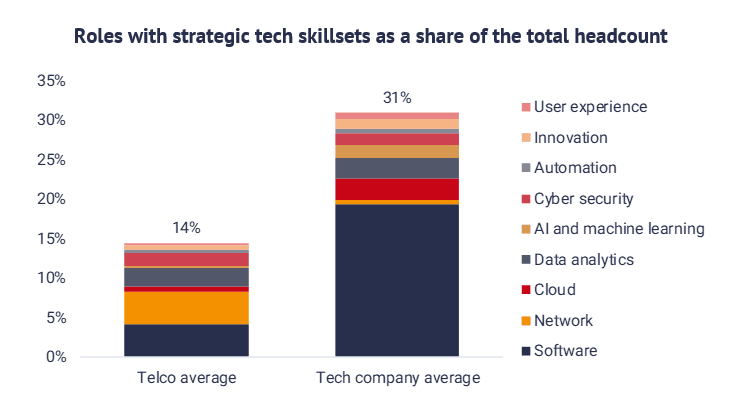
The telecommunications industry is at a pivotal juncture, with a recent study by STL Partners underscoring the significant gap in tech skills acquisition between telcos and their tech company counterparts. According to the research, telcos are approximately six years behind hyperscalers and similar tech companies in securing essential skills such as artificial intelligence (AI), innovation, and user experience. This gap poses a critical challenge for telcos aiming to leverage the opportunities presented by open, software-based networks in the future.
The study identified nine key skill categories vital for telcos, encompassing software, cloud, cybersecurity, AI, and innovation. Among the telcos examined, Swisscom, Singtel, and Telstra emerged as leaders, with more than 20% of their workforce engaged in roles related to these future capabilities. However, the broader picture reveals a stark contrast: on average, only 14% of jobs in telcos focus on these critical areas, compared to 31% in tech companies.
Despite some progress, with telcos accelerating their acquisition of future capabilities over the past year—particularly in software, data analytics, cybersecurity, and automation—the investment in areas like automation, user experience, and AI remains insufficient. Marina Koytcheva, research director at STL Partners, stresses the urgency of acquiring these skills swiftly, given the intense competition for top tech talent. The ability of telcos to upskill their current workforce rapidly will be a determining factor in their future growth and competitiveness.
The findings from STL Partners serve as a wake-up call for the telecommunications industry. Building key tech capabilities is not just a strategic priority but a necessity for telcos to realize their ambitions in a digital-first world. For more insights into how telcos can bridge the tech skills gap, visit https://www.stlpartners.com.