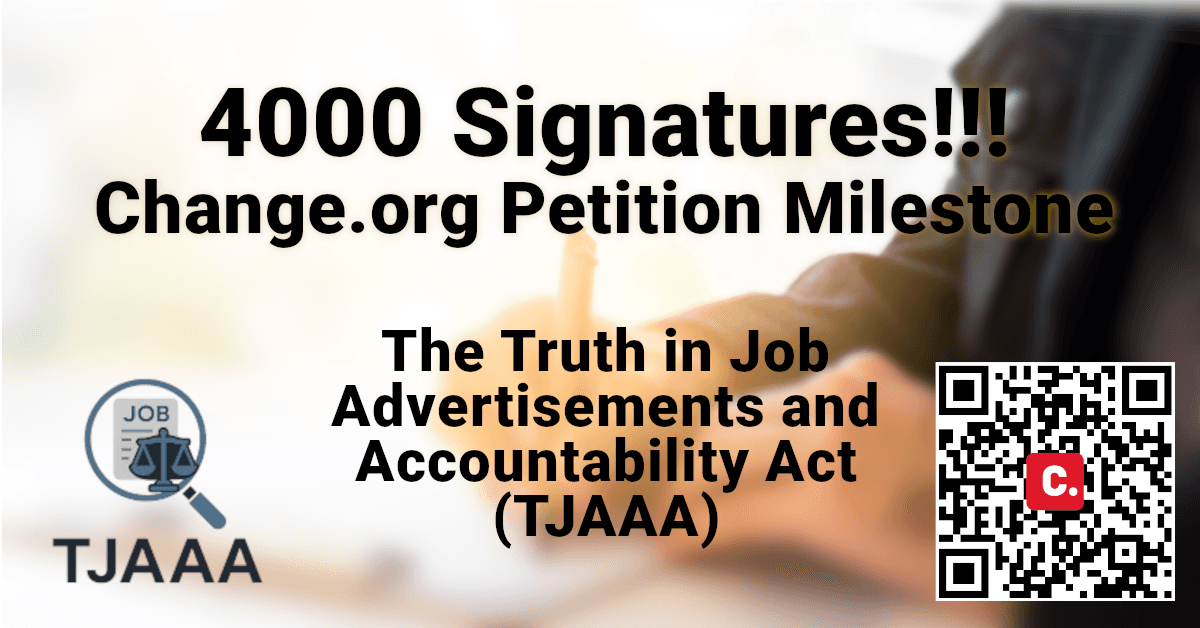
More than 4,000 Americans have signed a petition supporting the Truth in Job Advertising and Accountability Act, a citizen-driven initiative demanding transparency and honesty in employment postings. The rapid growth of support underscores a national call to end the spread of so-called ghost jobs—positions advertised with no intent to hire.
In the past week alone, the TJAAA Working Group has met with staff from the offices of Senator James Lankford and Representatives Nikema Williams, Eugene Vindman, Brad Sherman, Terri Sewell, Pablo José Hernández, Beth Van Duyne, Troy Downing, Monica De La Cruz, Henry Cuellar, and Tim Burchett. These discussions follow earlier conversations with Senator Ruben Gallego, Senator Jack Reed, and Representatives Debbie Dingell, Troy Carter, Gwen Moore, Maxwell Frost, Roger Williams, Alma Adams, and Keith Self.
Every signature represents someone who was ghosted, misled, or ignored in their job search, said Eric K. Thompson, founder of the TJAAA Working Group. Congress is starting to listen—not because of lobbyists, but because thousands of ordinary Americans are standing together to demand truth in hiring.
The TJAAA proposes common-sense measures to ensure job postings reflect genuine openings, prevent misuse of applicant data, and hold employers accountable for transparency in the hiring process. Supporters argue that deceptive listings inflate job-market statistics and waste millions of hours of unpaid applicant labor each year.
The petition, hosted at https://change.org/StopGhostJobs, continues to gain momentum as workers, job seekers, and business leaders call for reform. More information and legislative resources are available at https://www.truthinjobads.org.
For business and technology leaders, the implications of this movement extend beyond individual job seekers. The prevalence of ghost jobs distorts labor market data that companies rely on for strategic planning and investment decisions. When organizations advertise positions they have no intention of filling, they create false signals about labor demand that can misguide corporate expansion plans, hiring strategies, and market analysis.
The technology industry, known for its dynamic hiring practices, faces particular scrutiny as automated application systems and large-scale recruitment efforts could potentially contribute to the ghost job phenomenon. The proposed legislation could force companies to reevaluate their recruitment marketing strategies and ensure alignment between advertised positions and actual hiring needs.
Accountability measures in the TJAAA could also impact how companies handle applicant data, requiring clearer disclosures about how candidate information is used and stored. This has significant implications for HR technology platforms and recruitment software providers who may need to adapt their systems to comply with new transparency requirements.
The growing support for the Truth in Job Advertising and Accountability Act represents a broader shift toward demanding authenticity in business practices. As the movement gains congressional attention, employers across industries should prepare for potential regulatory changes that could fundamentally alter how they approach talent acquisition and recruitment marketing.