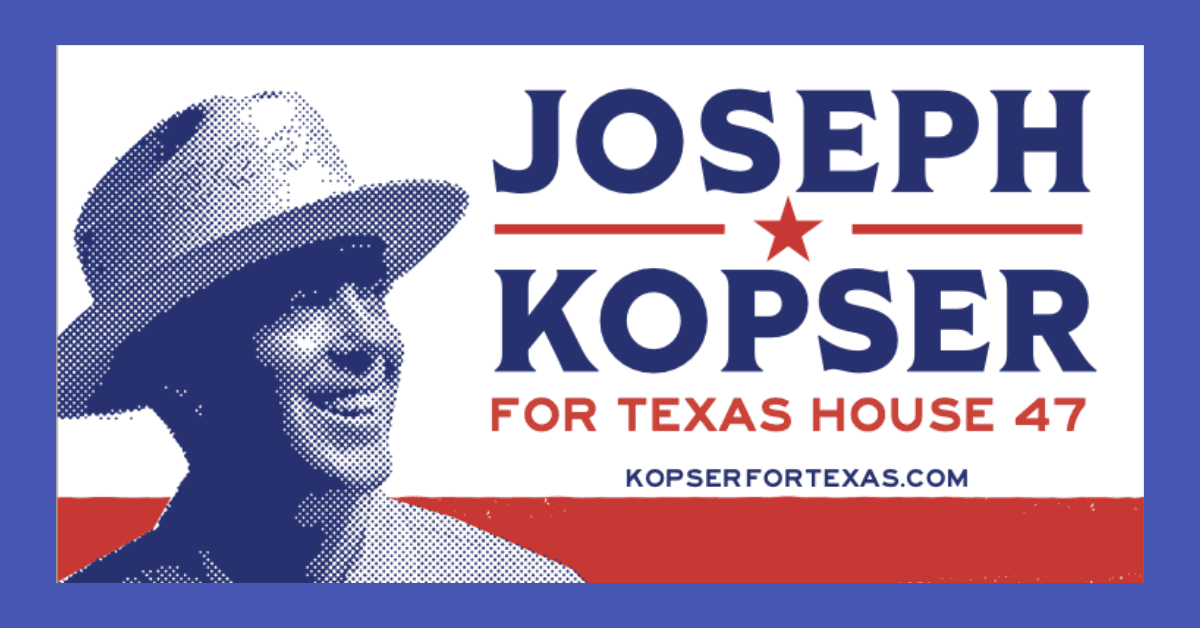
Campaign finance filings on January 15 reveal that Joseph Kopser raised more than $53,000 in the three weeks following his official entry into the race for Texas House District 47 on December 9. This fundraising occurred during a holiday period when political contributions typically decline, indicating robust early momentum for his campaign.
The funds were contributed by a diverse network of donors from sectors including clean energy, transportation, education, urban planning, and technology, alongside longtime supporters from Kopser's previous civic and entrepreneurial endeavors. This broad base of financial backing suggests a coalition forming around his candidacy as the March Democratic primary approaches.
Kopser stated that his campaign outraised his Democratic primary opponent by 35% during the same three-week timeframe. He emphasized the necessity of this financial readiness for effective voter communication and engagement, stating, "If we're going to fight back—and fight smarter—we have to be serious about communicating and engaging with voters."
The campaign has outlined four core priorities: standing up for healthcare, taking on rising costs, broadening the coalition, and remaining focused on substantive issues by being wary of distractions. These priorities are framed as central to addressing the concerns of Texas families.
House District 47 is an open seat, with early voting scheduled to begin on February 17 and Election Day on March 3. Given the heavily gerrymandered nature of the district, the winner of the Democratic primary is anticipated to become the next State Representative, as no runoff is expected. The early financial report, detailed in the campaign's https://www.newsworthy.ai press release, positions Kopser with significant resources to communicate his platform during the critical weeks leading to the primary.
For business and technology leaders monitoring political developments, this early fundraising success signals a candidate with established connections in technology and related innovation sectors. The campaign's ability to mobilize resources quickly from these industries may influence policy discussions around technology, infrastructure, and economic development in Texas. The outcome of this primary could determine legislative representation for a district with interests in these growing economic areas, making the financial viability of candidates a key indicator of their potential effectiveness and support base.