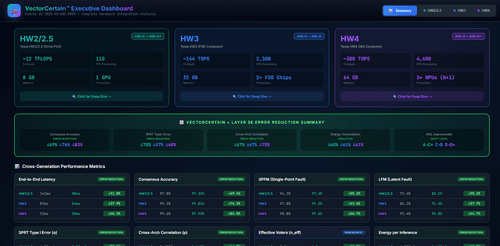
VectorCertain LLC announced the commercial availability of its Micro-Recursive Model with Cascading Fusion System, a new AI architecture designed to address critical safety vulnerabilities in systems controlling autonomous vehicles, medical diagnostics, and financial markets. The technology deploys ensembles of ultra-compact models—as small as 71 bytes each—to extend safety coverage into statistical tails where rare but catastrophic events occur.
Traditional AI systems consistently fail on the rare edge cases that cause catastrophic outcomes, creating significant risks as these systems increasingly control life-and-death decisions. The MRM-CFS architecture fundamentally changes what is possible in AI safety for mission-critical applications by offering precise detection and fusion solutions for these high-impact scenarios. VectorCertain's approach redefines AI safety through innovative sensor fusion techniques that operate within embedded, legacy, and regulated environments requiring low latency, fault tolerance, and auditable human oversight.
The company's breakthrough comes at a critical juncture for industries relying on AI for safety-critical functions. As AI systems become more integrated into infrastructure where failures have severe consequences, the ability to handle rare events moves from theoretical concern to practical necessity. VectorCertain's technology represents a shift from conventional AI approaches that excel at common scenarios but falter when encountering statistical outliers that can lead to system-wide failures.
For business and technology leaders, the implications extend across multiple sectors where AI reliability directly impacts operational safety and regulatory compliance. The architecture's compact size enables deployment in resource-constrained environments while maintaining the computational efficiency needed for real-time decision-making. This addresses a fundamental limitation in current AI safety approaches that often require extensive computational resources while still missing critical edge cases.
The commercial availability of MRM-CFS signals a maturation in AI safety technologies that could accelerate adoption in regulated industries. Organizations implementing AI for critical functions now have access to technology specifically engineered for the scenarios that cause the most severe failures. This development may establish new benchmarks for what constitutes acceptable AI safety in applications where human lives or significant assets are at stake.
VectorCertain's announcement positions the company at the forefront of addressing what has been described as AI's "tail risk" problem—the inability to handle statistically rare but high-impact events. As industries continue to integrate AI into increasingly sensitive applications, solutions like MRM-CFS may become essential components of responsible AI deployment strategies. The technology's availability through commercial channels means organizations can now implement these safety enhancements without developing proprietary solutions from scratch.
For more information about VectorCertain's technology and its applications, visit https://newsworthy.ai. The company's approach to AI safety through micro-recursive architectures represents a significant advancement in making AI systems more reliable and trustworthy for the most demanding applications.