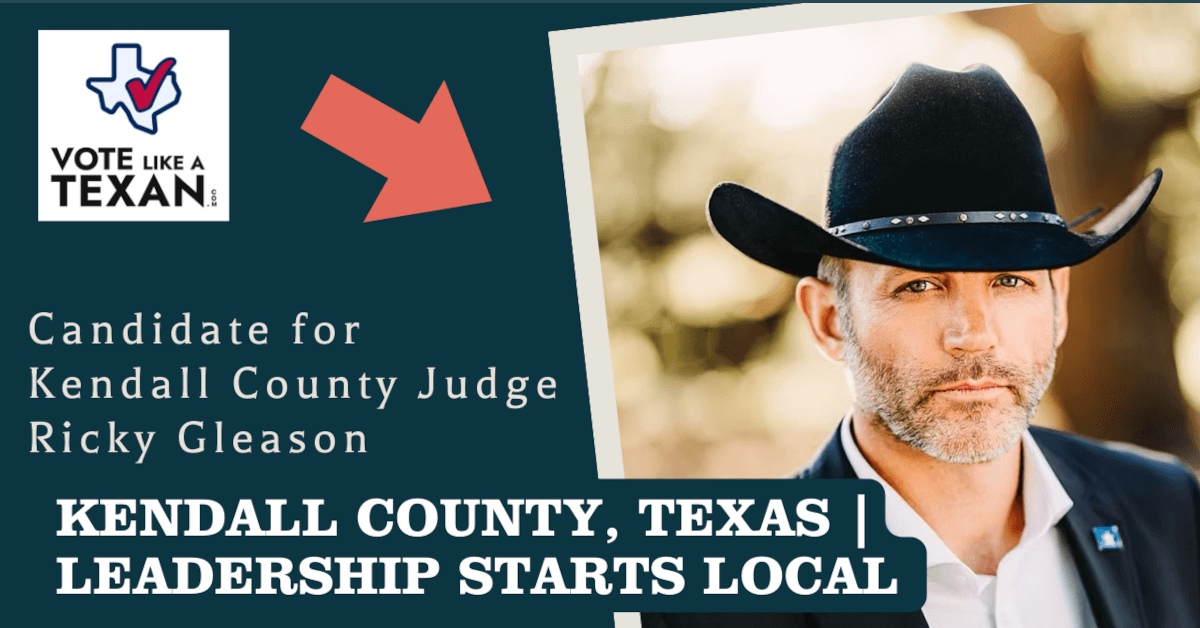
Ricky Gleason, candidate for Kendall County Judge, has introduced a three-horizon planning framework designed to manage the county's growth while prioritizing property rights and transparency. The approach focuses on structured collaboration rather than reactive or top-down mandates, with Gleason stating that planning should guide resource prioritization and taxpayer spending to achieve clarity, coordination, and decisions that respect property rights and protect quality of life.
The framework organizes planning into three actionable phases. The first phase, covering zero to three years, addresses immediate operational fixes such as safety, mobility, and emergency response needs based on verified conditions while avoiding unnecessary regulation. The second phase, spanning three to ten years, focuses on capital alignment to sequence infrastructure investments, particularly where mobility and water intersect, to prevent costly taxpayer mistakes. The third phase, extending ten to twenty-five years, involves scenario planning where citizens help shape long-range water sustainability and growth patterns through input-driven, flexible guidance.
Gleason emphasized that good planning is not about controlling land or restricting activities but about structuring a process that protects property rights while ensuring responsible handling of growth, infrastructure, and public safety. Central to this approach is using planning to guide rather than dictate outcomes, with early engagement of landowners during subdivision or project proposals to foster collaboration and avoid reactive measures like eminent domain. Gleason stressed that the county should not be in the business of taking land or dictating outcomes, noting that the best planning opportunities occur early through cooperation with property owners.
The candidate also highlighted the importance of local leadership before regional partnership, asserting that Kendall County must lead its own planning efforts before engaging with regional or state partners. He warned that without a local plan, external entities might impose their own vision, and residents desire leadership that prioritizes local work before forming regional partnerships to support that vision.
With rapid growth straining roads, water resources, and emergency services, Gleason's framework aims to replace short-term fixes with a coordinated, long-term strategy. This strategy seeks to protect property rights and reduce regulatory overreach, involve citizens, first responders, and experts in decision-making, align infrastructure spending with realistic growth projections, and safeguard water sustainability and rural character. For more information, visit https://www.rickygleason.com/.