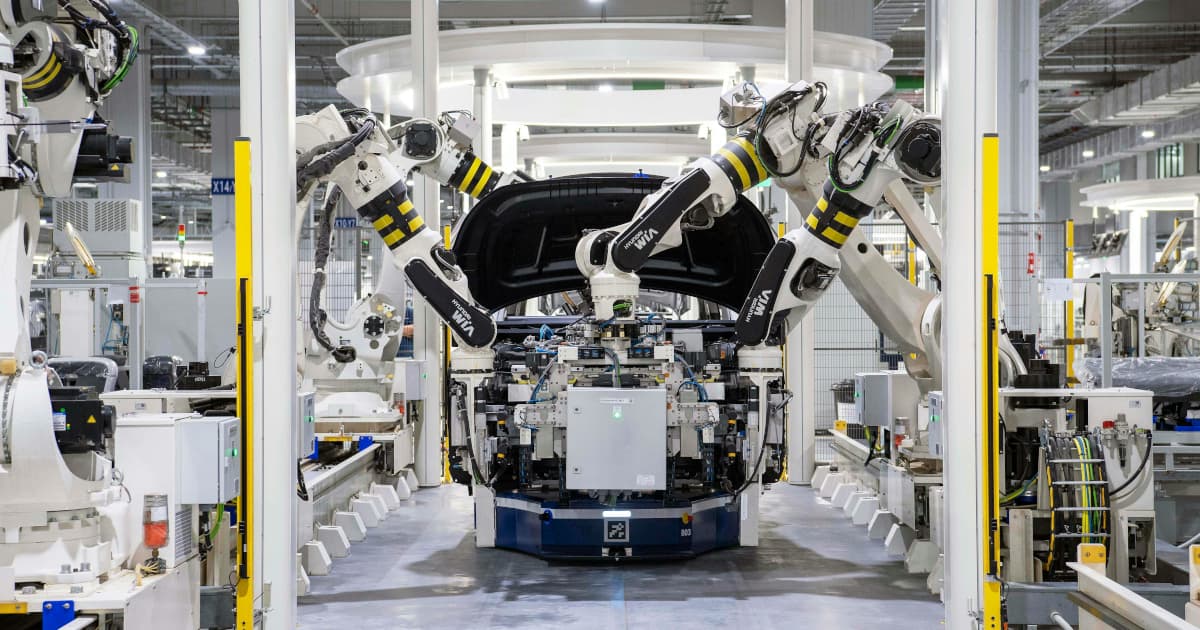
Xiaomi has conducted a pilot trial deploying two bipedal humanoid robots for active production work at its Beijing electric vehicle assembly plant. The robots operated for three hours during the trial, achieving a task completion rate above 90%. This implementation represents one of the first instances of humanoid robots being utilized on a working factory floor for electric vehicle manufacturing, moving beyond years of industry promises toward tangible proof of concept.
The successful trial at Xiaomi's facility suggests that humanoid robotics technology is reaching a maturity level applicable to complex manufacturing environments. For the electric vehicle industry, which faces intense pressure to optimize production efficiency and reduce costs, this development could signal a new phase of automation. The deployment indicates that tasks previously requiring human dexterity and mobility in constrained spaces may increasingly be handled by advanced robotic systems.
Other electric vehicle manufacturers are likely to monitor these developments closely as they consider their own automation strategies. Companies like Massimo Group (NASDAQ: MAMO) may face competitive pressure to adopt similar technologies to maintain production efficiency benchmarks. The broader automotive manufacturing sector, which has long utilized robotic arms for specific tasks, may now confront decisions about integrating more versatile humanoid systems into their operations.
The implications extend beyond individual companies to workforce dynamics, supply chain logistics, and global manufacturing competitiveness. As humanoid robots demonstrate capability in real-world production settings, businesses must evaluate how to integrate these systems with existing automation while addressing potential impacts on labor requirements and skill development. The technology's progression from research laboratories to factory floors represents a significant milestone in the convergence of artificial intelligence, robotics, and advanced manufacturing.
For industry leaders and investors tracking technological innovation, Xiaomi's trial provides concrete evidence of humanoid robotics' practical application in a high-stakes manufacturing sector. The over 90% completion rate suggests reliability is approaching levels necessary for commercial deployment, though further refinement and scaling will be required for full production integration. This development arrives as the electric vehicle market continues to expand globally, with manufacturers seeking every possible advantage in production quality, speed, and cost management.