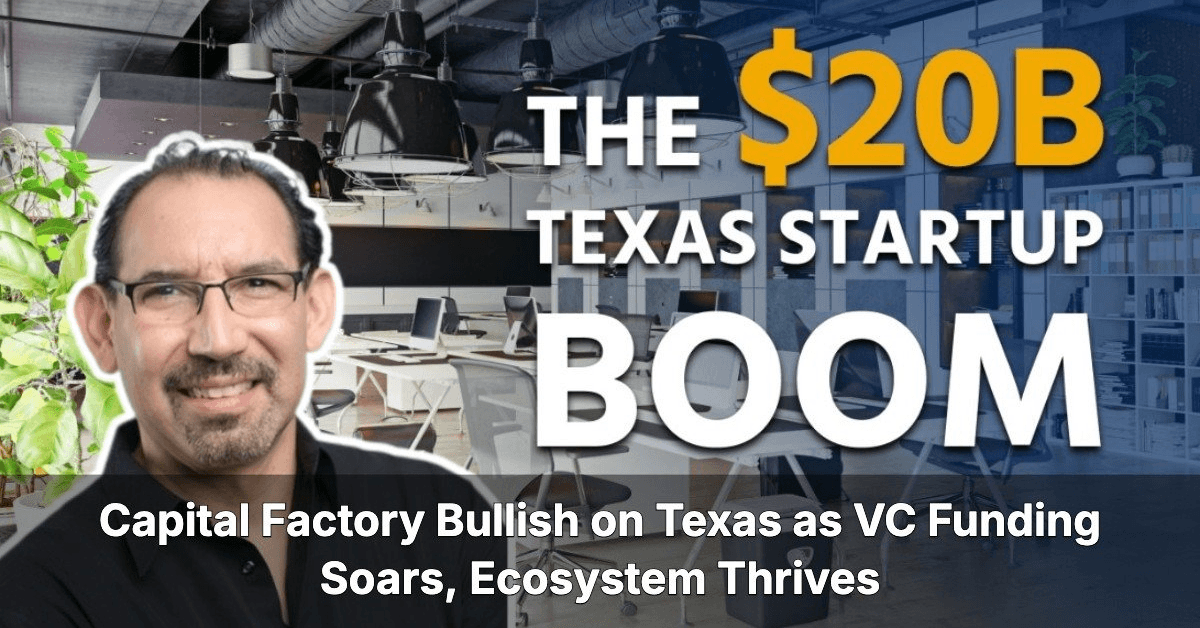
Texas has emerged as a dominant force in venture capital investment, with the state attracting nearly $20 billion in funding during 2025 while Austin secured approximately $8 billion alone, according to Luis Martinez of Capital Factory. This performance places Austin among the top five cities nationally for venture capital activity, with Houston and Dallas-Fort Worth also showing substantial growth. Martinez predicts 2026 will be "a banger year" for Texas venture capital, citing the state's strategic advantages across multiple high-growth sectors.
The space industry represents one of Texas's most dynamic sectors, with Martinez describing the excitement as "red hot." The state hosts industry leaders including Blue Origin, Intuitive Machines, and Firefly, while the inaugural Space Summit scheduled for September in San Antonio is expected to further galvanize activity. Texas has historically been number one in energy, and this leadership continues through innovation in solar power and significant investment in nuclear energy technologies including small modular reactors and fusion to meet demands from AI data centers and emerging industries.
Healthcare and life sciences represent another growth area, with collaborations involving institutions like MD Anderson, Baylor College of Medicine, and UT Southwestern. Public initiatives such as CIPRI for cancer research and DeepRIT for neurodegenerative diseases provide critical support for this sector. Texas is also seeing significant hardware innovation across chemicals, automotive, aerospace, and advanced materials, with companies like Toyota maintaining substantial presence in the state.
While Texas's favorable tax structure and efficient regulatory frameworks provide foundational advantages, Martinez identifies three key elements that constitute the state's "special sauce." Critical mass comes from a high concentration of experienced founders and companies engaged in their second, third, or fourth successful ventures. A collaborative ecosystem features natural flows of talent and relationships across major cities, with regional cooperation among angel networks including CTAN, Houston Angel Network, North Texas Angel Network, and Alamo Angels, along with economic development corporations and universities. Strategic public investment through initiatives like CIPRI, DeepRIT, and the Texas Space Commission helps de-risk and catalyze private investment in priority sectors.
The implications of Texas's venture capital surge extend beyond state borders, challenging traditional technology hubs and creating new competitive dynamics in the global innovation landscape. For business leaders, this represents both opportunity and disruption as talent, capital, and innovation increasingly concentrate in Texas. The state's ability to attract nearly $20 billion in venture funding signals a fundamental shift in where technology innovation occurs and how ecosystems develop, with Texas demonstrating that collaborative regional approaches can compete effectively against more established technology centers.