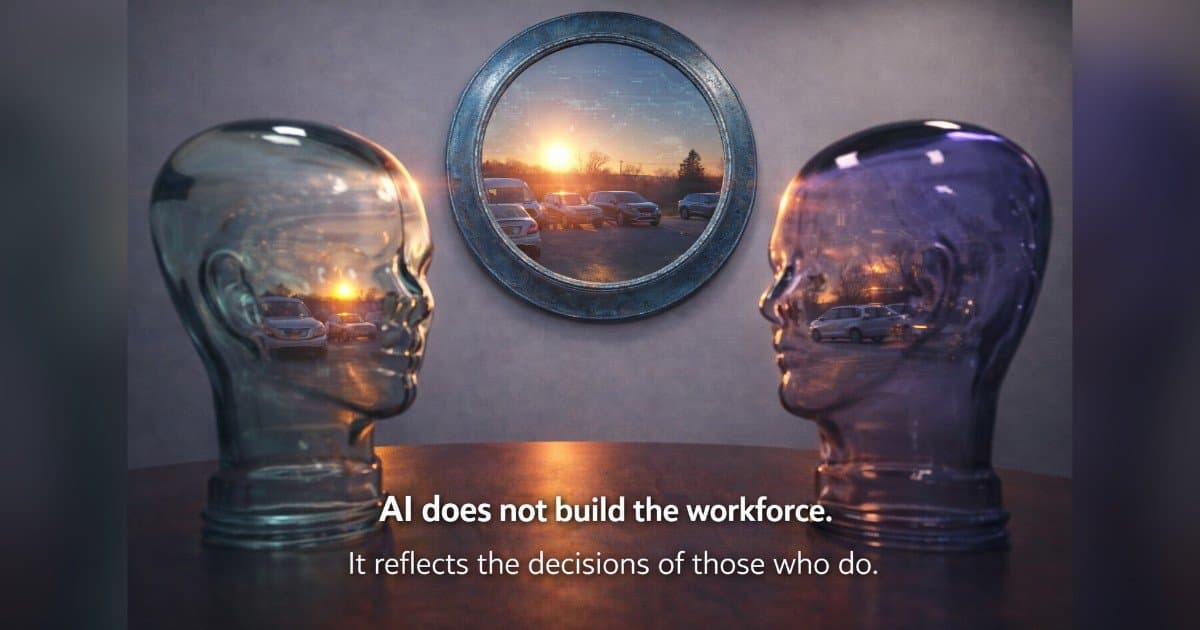
Artificial intelligence represents a transformative tool for industrial sectors, but its effectiveness depends entirely on human cognition, contextual judgment, and domain-specific expertise. The growing conversation around AI in manufacturing environments reveals a critical insight: technology alone cannot produce meaningful outcomes without the interpretive capacity of skilled professionals who understand industrial science, application, and mechanics.
Industrial STEM education has emerged as the essential framework for preparing leaders and skilled workers who can bridge the gap between AI capabilities and operational reality. This approach integrates technical knowledge with applied industrial practice, creating professionals who can translate data into actionable insights within specific manufacturing contexts. As Dr. Andrew Johnson III emphasizes in his article on workforce education, the real risk facing industry is not AI replacing humans, but failing to prepare humans to use AI effectively.
The evolution of measurement and decision-making illustrates this dynamic. Modern systems can capture variables automatically through sensors, onboard diagnostics, and intelligent analysis tools, enabling predictive and preventive approaches that were previously impossible. However, these capabilities introduce new demands for interpretation. A prediction generated by AI is only valuable if industrial professionals can determine whether recommendations align with safety regulations, production deadlines, workforce capabilities, and real-world constraints.
Consider the analogy of automotive tire warranties. While technology can now track mileage, driving conditions, tread wear, and environmental factors automatically, proving whether tires failed to meet projected lifecycle still requires human understanding of what constitutes normal conditions and legitimate evidence. This simple example demonstrates a fundamental truth: data can describe performance, but human thought proves value.
In industrial settings, context determines everything. AI can process data at extraordinary speeds, detect anomalies human eyes might overlook, and generate predictive models that reduce downtime. Yet AI lacks understanding of welding tolerances, machining variances, maintenance behavior patterns, process flow bottlenecks, or safety culture. The tool requires one component that cannot be generated artificially: the cognitive thought of a human who understands why data matters within specific manufacturing environments.
The future workforce requires professionals who possess technical literacy, systems thinking, applied problem-solving, interdisciplinary understanding, and decision-making grounded in context. Educational institutions and industry leaders face a critical decision point: whether to train individuals merely to use technology or to develop thinkers who understand how technology fits inside real industrial systems. The latter approach creates leaders rather than operators, with industrial experience becoming increasingly valuable as AI expands.
Interpretive leadership represents the new essential capability in industrial environments. Leaders must now understand both technology and the human systems around it, asking whether AI recommendations align with operational realities, solving the right problems, considering downstream consequences, and helping workers trust AI-driven insights. These judgments require experience, ethics, and contextual understanding that AI cannot provide.
The future of industry will be defined by collaboration between human cognition and intelligent tools, with AI monitoring equipment health while skilled professionals interpret recommendations and leaders make decisions balancing efficiency with safety and quality. This human-centered industrial intelligence depends on one factor that cannot be automated: the ability to connect data to physical processes, which has become the competitive advantage in modern manufacturing.