

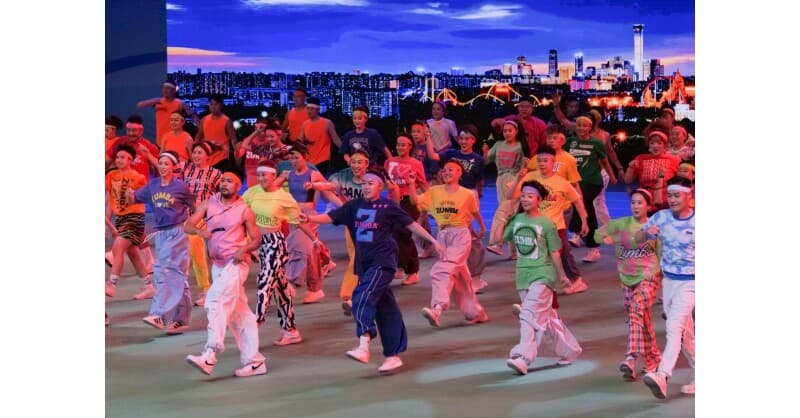
The 17th Beijing Sports Games officially opened on August 8, coinciding with China's 18th National Fitness Day, at the National Indoor Stadium. The event, which will run through October, is expected to draw around 35,000 participants, a record number, and features a mix of traditional sports like athletics and swimming alongside emerging ones such as pickleball and breakdancing.
The opening ceremony was attended by 14 champion athletes who trained in Beijing, including table tennis stars Ma Long, Zhang Yining, Ding Ning, and Wang Chuqin, as well as gymnast Xiao Ruoteng, diver Cao Yuan, and tennis legend Li Na. Their presence is intended to inspire greater public participation in sports. Zhang Yining, a former Olympic table tennis champion, expressed gratitude to Beijing for helping her realize her dreams and encouraged children to pursue their sporting aspirations, noting that "Beijing is a place where dreams come true."
The Games are designed to balance competitive and mass participation events, reflecting Beijing's broader strategy of weaving sports into the fabric of the city. According to the Beijing Municipal Sports Bureau, the city now boasts 3.27 square meters of sports venue space per capita, and 53.1% of its population regularly engages in physical exercise. These statistics underscore a significant shift toward sports and fitness as a lifestyle, particularly in a city celebrated as the "Dual Olympic City" for hosting both the Summer and Winter Olympics.
Yin Shen, a 20-year-old football enthusiast who attended the ceremony, noted that the mass participation events felt more relatable than purely competitive ones. "It's great to see so many sports that ordinary people usually play. Sports are actually all around us," he said. This sentiment highlights the Games' role in democratizing sports and encouraging everyday citizens to get involved.
The implications of this event extend beyond mere spectacle. By integrating mass participation with elite competition, Beijing is setting a precedent for how cities can leverage major sporting events to promote public health and community engagement. The record participation numbers and the inclusion of non-traditional sports indicate a broadening of the sports ecosystem, which could influence how other cities design their own athletic programs.
For business and technology leaders, the Beijing Sports Games represent a significant opportunity for investment and innovation. The emphasis on emerging sports like pickleball and breakdancing suggests new markets for equipment, apparel, and technology-enhanced training tools. Additionally, the city's investment in sports infrastructure and its high participation rates create a fertile ground for startups and established companies focused on fitness and wellness technologies.
As the Games unfold over the coming months, they will not only showcase athletic talent but also serve as a case study in urban sports development. The event's success could inspire other metropolises to adopt similar models, potentially reshaping how cities approach public health and recreational programming in the post-pandemic era.
