

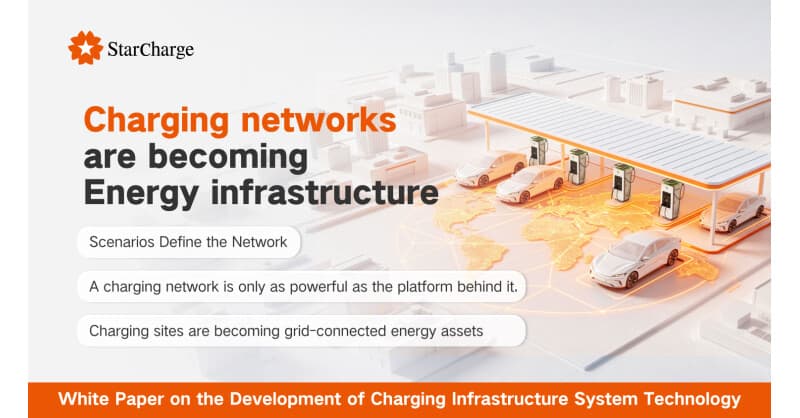
StarCharge, a global leader in EV charging equipment and smart energy systems, released two white papers at an industry seminar in Hong Kong, highlighting transformative trends in the EV charging and energy sectors. The papers argue that charging stations are evolving from mere vehicle support into smart energy nodes that connect vehicles, the grid, distributed energy, storage, and digital management. This shift from infrastructure to network systems marks a move toward integrated value, where charging services expand into energy services, standalone stations become PV-storage-charging systems, and equipment deployment transforms into scenario-based infrastructure.
According to StarCharge's Technical White Paper, the charging network ecosystem will undergo four major turning points. First, charging networks are becoming strategic energy infrastructure, linking mobility demand with the grid and distributed energy. Second, scenarios will define network design rather than hardware alone, with different needs for urban commuting, highway trips, ride-hailing, logistics, and autonomous driving. Third, digital platforms will turn charging networks into operable assets, enabling site selection, pricing, marketing, and energy optimization. Fourth, charging stations will become grid-friendly energy resources through technologies like V2G, PV-storage-charging, and AI-driven operations, allowing them to absorb renewable energy, buffer peak loads, and provide grid services.
The white paper on scenario-based microgrid technology notes that microgrids are moving from customized engineering projects toward scalable, replicable energy systems. A microgrid is a local energy system designed around specific scenarios, such as data centers, charging stations, zero-carbon industrial parks, or green mines. StarCharge identifies four high-value paths: electricity-computing synergy, independent power supply, zero-carbon parks, and green mines. In areas with weak grids, microgrids ensure critical load operation, while in data centers and industrial parks, they support renewable integration and cost optimization.
The evolution of microgrids is described in three stages: Microgrid 1.0, dominated by AC architecture; Microgrid 2.0, a hybrid AC-DC stage expected to remain mainstream for 10-15 years; and Microgrid 3.0, an era of DC microgrids that reduce conversion losses and simplify control. This evolution aligns with the mission of breaking energy access bottlenecks and enabling sustainable development.
For business leaders, these developments signal that EV charging and energy management are converging, creating new opportunities for energy services, data monetization, and grid interaction. Companies investing in charging infrastructure should consider integrating energy storage, renewable generation, and digital platforms to maximize asset value. The shift from customized to scalable microgrids also opens avenues for standardized solutions in commercial and industrial applications.
StarCharge plans to expand globally, leveraging its smart energy systems validated in China. The white papers underscore the importance of scenario-based design and digitalization in building future-proof energy networks.
