

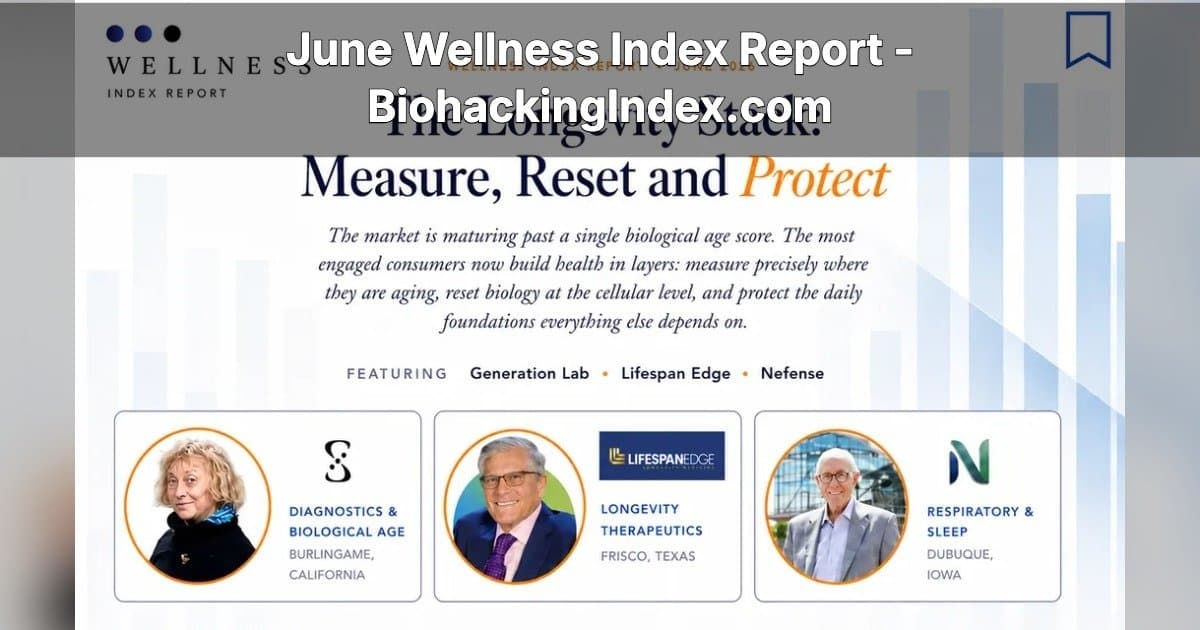
The latest Wellness Index Report, published by Wellness Eternal's Biohacking Index, signals a meaningful shift in consumer health priorities. After years of focusing on lifespan and longevity metrics, individuals are now asking a different question: not "how do I live longer," but "why do I feel the way I do, and how do I improve my quality of life today." The report, drawn from verified practitioner and user feedback across the wellness, longevity, and biohacking industry, identifies three key trends shaping this new chapter.
First, personalized diagnostics are moving from elite clinics into everyday wellness. Consumers want to uncover the root causes behind fatigue, inflammation, poor sleep, and slow recovery rather than manage symptoms in the dark. Advanced testing, biological-age insights, and data-driven personalization are becoming the starting point of a wellness journey instead of a luxury add-on. Second, demand for non-pharmaceutical pain management is rising sharply. People are actively seeking drug-free options for recovery and relief, from targeted bodywork and regeneration tools to modalities that address the source of discomfort rather than mask it. The report notes that at-home and practitioner-guided recovery is one of the fastest-moving categories in the index. Third, human connection, purpose, and mental wellness are back at the center. As the industry matured, something got lost in the pursuit of optimization. The report finds a clear return to emotional resilience, community, and meaning as core pillars of health, not soft extras.
Taken together, the findings point to an integrated model of wellness for the year ahead, one that combines personalized diagnostics, preventive strategies, emotional resilience, non-pharmaceutical pain management, and human connection into a single approach. "For a long time the conversation was about adding years," said Lindsay O'Neill-O'Keefe, Founder of Wellness Eternal and the Biohacking Index. "What we're seeing now is people asking for those years to actually feel good. They want to understand the root cause, manage pain without a prescription, and reconnect with the things that make life worth extending. The future of this industry isn't longevity for its own sake. It's whole-person health."
The report features three companies building what it calls "the longevity stack." Generation Lab, based in Burlingame, California, offers diagnostics and biological age testing. Co-founded by Dr. Irina Conboy, PhD, a UC Berkeley bioengineering professor, Generation Lab's SystemAge test measures biological aging across 460 biomarkers and 21 organs and systems from a single at-home, needle-free blood sample. Results arrive as a full aging report paired with a personalized action plan, with optional professional consultation and retesting to track progress. When you can see which systems are aging fastest, prevention finally has a target.
Lifespan Edge, based in Frisco, Texas, focuses on longevity therapeutics. Co-founded in 2024 by Dr. Michael Roizen, Chief Wellness Officer Emeritus of Cleveland Clinic, alongside entrepreneur John Mauldin, Lifespan Edge delivers physician-led Therapeutic Plasma Exchange (TPE) through a standardized protocol designed to filter inflammatory proteins and cellular waste from the bloodstream. Targeting inflammation, cognition, cellular resilience, cardiovascular health, and energy, the treatment is guided by biomarker data rather than guesswork. With clinics across the United States and Puerto Rico, Lifespan Edge is building one of the largest TPE datasets in the field. TPE is not about managing aging; it is about resetting the system.
Nefense, based in Dubuque, Iowa, addresses respiratory and sleep health. Founded by Dr. Richard "Rick" Downs, DDS, a dental sleep medicine veteran, Nefense focuses on the foundation everything else depends on: how well you breathe. The company builds physician-trusted nasal care on hypochlorous acid (HOCl), the same molecule the immune system produces naturally. Its flagship HypoNasal uses pure HOCl to break down impurities and calm inflammation, while XyloClean uses xylitol to hydrate and protect nasal passages. Adopted by dentists treating airway, breathing, and sleep disorders, ENTs, and integrative providers, the line is natural, non-invasive, and non-habit-forming. Better breathing is not a luxury; it is the base of better sleep and better health.
The Wellness Index Report is a practitioner-led evaluation platform that assesses wellness providers and technologies through a four-step process: expert nomination, customer feedback, clinical and scientific review, and ongoing rating analysis. Verified expert feedback is gathered through a proprietary survey delivered monthly to more than 100,000 doctors, clinic and wellness-center owners, and biohackers, through partnerships with medical-education leader Boston BioLife and the naturopathic research journal NDNR.com. The Report is an independent research platform designed to provide transparent, third-party validation in the rapidly growing wellness and biohacking industry.
For leaders in business and technology, this shift represents a growing market opportunity. The emphasis on personalized diagnostics, non-pharmaceutical interventions, and mental wellness suggests that companies investing in data-driven health solutions and integrative care models may be well-positioned to meet evolving consumer demands. The integration of advanced testing and therapeutic technologies into everyday wellness could reshape how employers approach employee health benefits, how insurers design coverage, and how tech companies build health-focused platforms. As the industry moves from a narrow focus on longevity to a broader whole-person health paradigm, stakeholders across sectors should pay attention to the trends outlined in this report.
