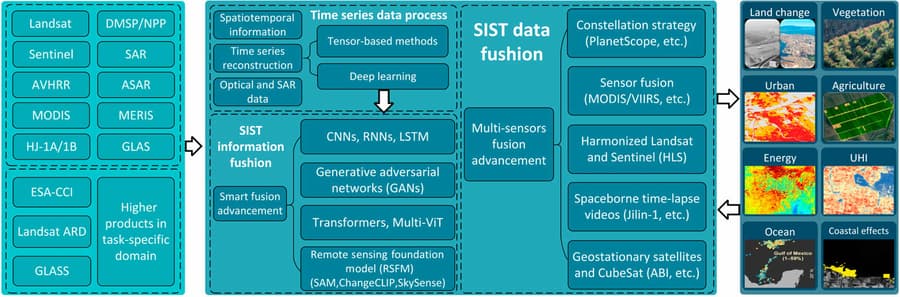
A recent study published in the Journal of Remote Sensing introduces a groundbreaking methodology for remote sensing time series analysis, promising to transform environmental monitoring and urban planning. Developed by an international team, this approach combines deep learning algorithms with conventional remote sensing techniques to analyze terrestrial changes in near real-time.
The methodology leverages Long Short-Term Memory (LSTM) networks and Generative Adversarial Networks (GANs) to enhance the accuracy of time series data. LSTM networks are utilized to identify temporal patterns, while GANs generate synthetic data to compensate for gaps and atmospheric distortions. This innovative combination has been validated against ground measurements, showing notable improvements in vegetation indices like the Normalized Difference Vegetation Index (NDVI).
This advancement is particularly timely, as the demand for precise and timely environmental data grows alongside urbanization and shifting environmental dynamics. The study's findings could revolutionize applications in agricultural surveillance, urban development, and environmental conservation, providing a more detailed understanding of terrestrial changes.
Professor Fu, a contributor to the research, highlights the method's potential in addressing global challenges such as climate change. The integration of data from Landsat and Sentinel-2 satellites into this framework enables continuous and accurate terrestrial analysis, setting a new standard in remote sensing.
Supported by the National Nature Science Foundation of China, this research underscores the critical role of investment in remote sensing technology. As computational capabilities advance, this methodology is expected to become indispensable in natural resource management, disaster response, and efforts to mitigate climate change impacts.
The study, accessible via DOI:10.34133/remotesensing.0285, represents a significant leap forward in our capacity to monitor the Earth's environment, offering tools to tackle some of the most urgent environmental challenges facing the planet today.