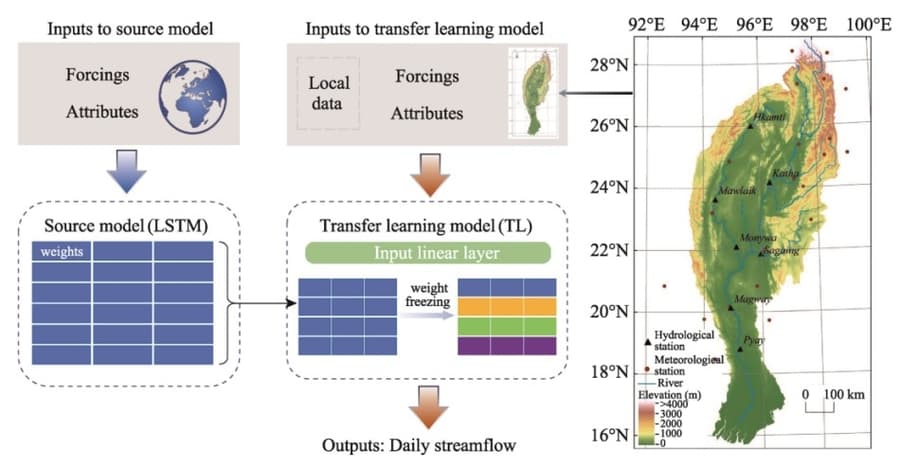
A groundbreaking study by researchers from Yunnan University and Pennsylvania State University introduces a novel transfer learning framework that significantly enhances the accuracy of daily streamflow forecasts in regions where data is scarce. Published in the Journal of Geographical Sciences, this research addresses critical challenges in streamflow modeling, providing a new tool for water security in vulnerable areas.
The study focuses on the application of transfer learning techniques to overcome the limitations posed by sparse gauge distribution and data scarcity in large transboundary basins. These areas are crucial for water supply and climate change impact assessment but have been historically difficult to model due to complex hydrological processes and insufficient data. The researchers tested their framework in the Dulong-Irrawaddy River Basin, achieving promising results that outperform traditional process-based models.
One of the key advantages of this transfer learning approach is its ability to capture intricate, nonlinear interactions among variables, improving prediction accuracy and deepening our understanding of complex hydrological systems. Dr. Ma Kai, a principal investigator of the study, highlights the research's significance in meeting the urgent demand for reliable streamflow predictions in data-limited regions.
The implications of this study are vast, especially as climate change continues to alter precipitation patterns and water availability globally. The transfer learning framework offers a powerful tool for decision-makers and water managers, particularly in transboundary basins where data scarcity has hindered accurate predictions. This could lead to more informed and collaborative water management strategies, preventing conflicts over water resources and supporting equitable water allocation.
Furthermore, the model's success in the Dulong-Irrawaddy River Basin suggests potential applications in other data-scarce regions worldwide, especially in developing countries or remote areas. The enhanced understanding of hydrological processes provided by this model could also contribute to more effective climate change mitigation and adaptation strategies, aiding in decisions about water infrastructure, flood control, and ecosystem conservation.
Supported by funding from the National Key Research and Development Program of China, the National Natural Science Foundation of China, and the China Postdoctoral Science Foundation, this research represents a significant advancement in hydrological science. It offers hope for more resilient and sustainable water management practices, democratizing access to accurate hydrological forecasting for data-scarce regions globally.