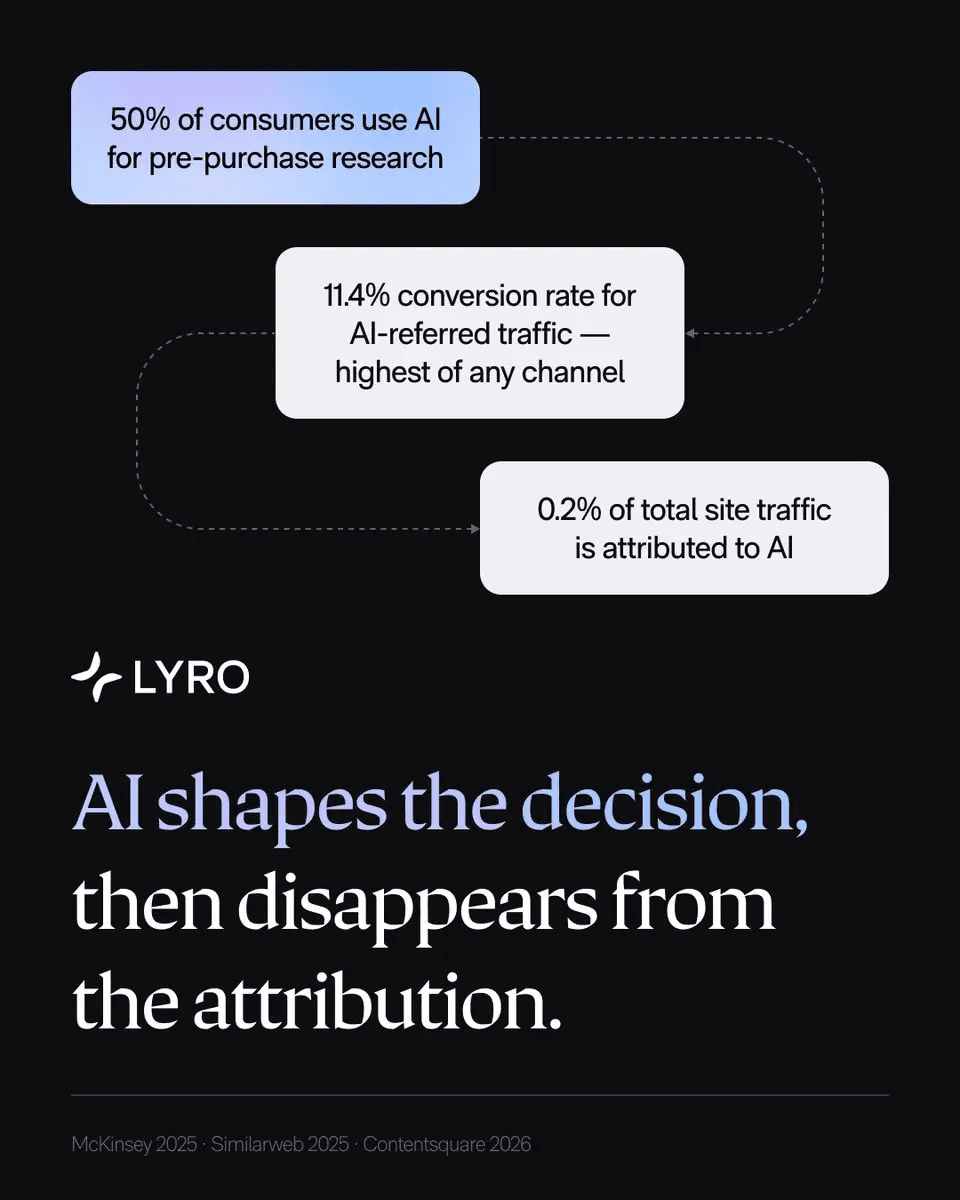
New research from Tidio reveals a significant disconnect between how consumers use artificial intelligence for shopping and how businesses measure its impact. While McKinsey research indicates half of consumers now rely on AI as their primary or preferred source for product research, Contentsquare's analysis of actual retail web traffic shows AI-referred sessions account for only 0.2% of total visits. This substantial gap between influence and attribution forms what Tidio's report identifies as a 'dark AI' phenomenon in e-commerce measurement.
The implications of this measurement gap are substantial for business leaders and marketing professionals. According to McKinsey projections, approximately $750 billion in U.S. revenue will flow through AI-powered search by 2028. Brands that fail to prepare for this shift risk losing 20–50% of their traditional search traffic. Morgan Stanley estimates further reinforce the scale of AI's economic impact, projecting that AI agents will influence between $190 billion and $385 billion in U.S. e-commerce spending by 2030.
Current attribution systems appear to capture only the most direct AI interactions while missing the broader influence AI exerts throughout the consumer journey. Similarweb data provides insight into the quality of measurable AI traffic, showing that ChatGPT-referred U.S. retail sessions convert at 11.4%, the highest conversion rate of any measured channel. This suggests that tagged AI referrals represent high-intent traffic from a much larger pool of AI-influenced consumer journeys that current analytics cannot properly attribute.
The research indicates that AI's role in consumer decision-making extends far beyond what traditional web analytics can track. As consumers increasingly turn to AI assistants for product research and recommendations, businesses face challenges in understanding the true impact of these interactions on purchasing behavior. This measurement gap creates strategic blind spots for companies attempting to optimize their marketing investments and customer experience initiatives.
For technology and business leaders, the findings highlight the need for new measurement frameworks that can better capture AI's influence throughout the customer journey. The discrepancy between reported AI usage and measurable AI traffic suggests that current analytics tools may be significantly underestimating AI's role in driving revenue. This has implications for resource allocation, marketing strategy, and competitive positioning in an increasingly AI-driven commerce landscape.
The research from Tidio, an AI-powered customer service platform that unifies live chat, chatbots, and AI agents in one help desk, points to broader industry challenges in tracking and understanding AI's commercial impact. As AI continues to reshape consumer behavior and business operations, developing more sophisticated measurement approaches will become increasingly critical for companies seeking to maintain competitive advantage in digital commerce.