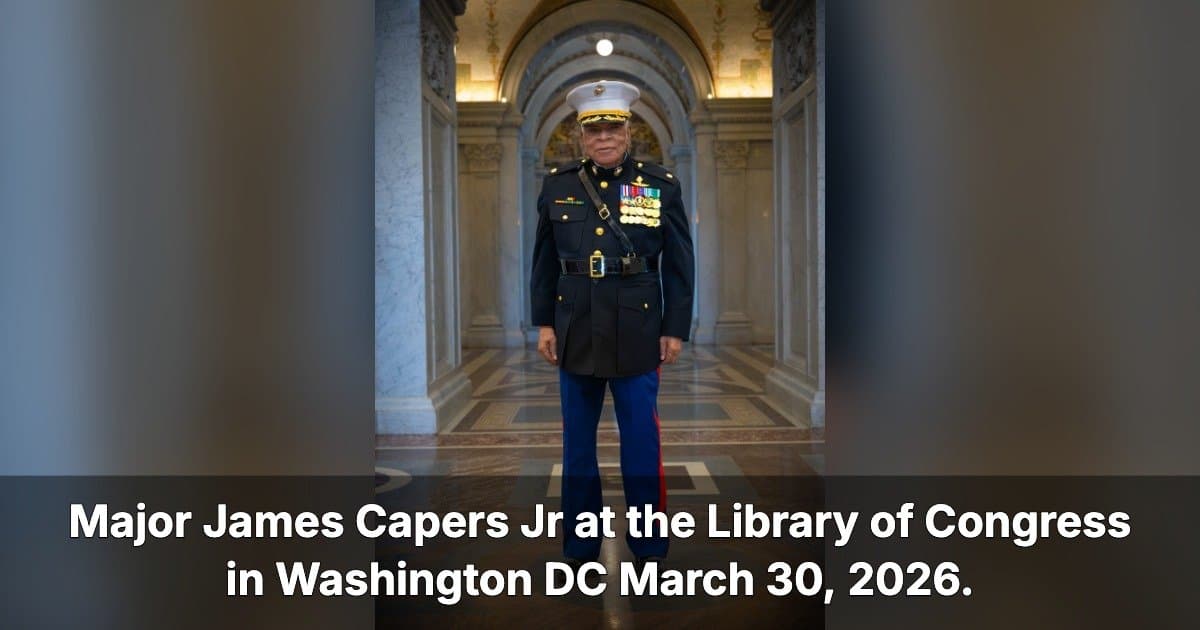
The Library of Congress Veterans History Project has permanently archived the oral history of Major James Capers Jr., a pioneer of Marine Force Recon who is designated to become the first Black Marine officer in United States history to receive the Medal of Honor. During his visit to the Library of Congress, Major Capers provided a firsthand account of his 64 long-range reconnaissance patrols in Vietnam and his role as the face of the Marine Corps' first fully integrated national recruitment campaign in 1967.
Major Capers stands as a significant figure in military history, having broken racial barriers to become the first African American Marine promoted from enlisted to officer via a battlefield commission. His career includes induction into the U.S. Special Operations Command (USSOCOM) Commando Hall of Honor, where his tactics remain foundational to special operations forces today. The archival recording captures his experiences as a member of the elite "Team Broadminded" and details his extensive personal decorations, including the Silver Star Medal, Bronze Star with two Gold Star and Combat V, Purple Heart with three Gold Stars, and Vietnam Cross of Gallantry.
The induction ceremony followed the March 2026 signing of H.R. 3377 into law, which officially authorizes the President to award the Medal of Honor to James Capers Jr. for acts of valor as a member of the Marine Corps during the Vietnam War. This legislative action culminated a process that began when Congressman Walter P Jones of North Carolina's 3rd district submitted Major Capers for the Congressional Medal of Honor in 2007.
The Veterans History Project (VHP) at the Library of Congress serves as the repository for this historic account, fulfilling its mission to collect, preserve, and make accessible the firsthand recollections of U.S. military veterans. Researchers can access materials through the project's resources at https://www.loc.gov/vets/. The archival process involved coordination between family members, Library of Congress staff, and VHP leadership who worked together to document the Major's legendary Marine Corps career.
For business and technology leaders, this preservation effort demonstrates how institutional archives can leverage modern recording technologies to capture historical narratives that might otherwise be lost. The Library of Congress's systematic approach to veteran histories creates valuable primary source materials for researchers, educators, and future generations seeking to understand military history and leadership development. Major Capers' story particularly highlights how organizational integration and diversity initiatives have evolved over decades, with his 1967 recruitment campaign representing an early example of inclusive military representation.
The inclusion of family members in the archival process adds depth to the historical record, as demonstrated by researcher Aneesah Akbar-Uqdah, a Capers daughter who is currently conducting research on Maritime Law and Port Health & Security within the same Main Reading Room where her father's oral history will be permanently archived. This multigenerational connection to knowledge preservation underscores how institutional archives can serve both historical documentation and ongoing research needs. Additional visual materials from the induction are available through the official media resources at https://www.majorcapers.com.
For industries focused on leadership development and organizational history, Major Capers' archived account provides case study material on barrier-breaking leadership under extreme conditions. His transition from sharecropper's son to decorated officer and his continued mentoring within the Special Operations community offer insights into resilience, tactical innovation, and the long-term impact of inclusive policies. The Veterans History Project's work ensures that such leadership narratives remain accessible for analysis and inspiration, contributing to our understanding of how individual excellence shapes institutional evolution.