

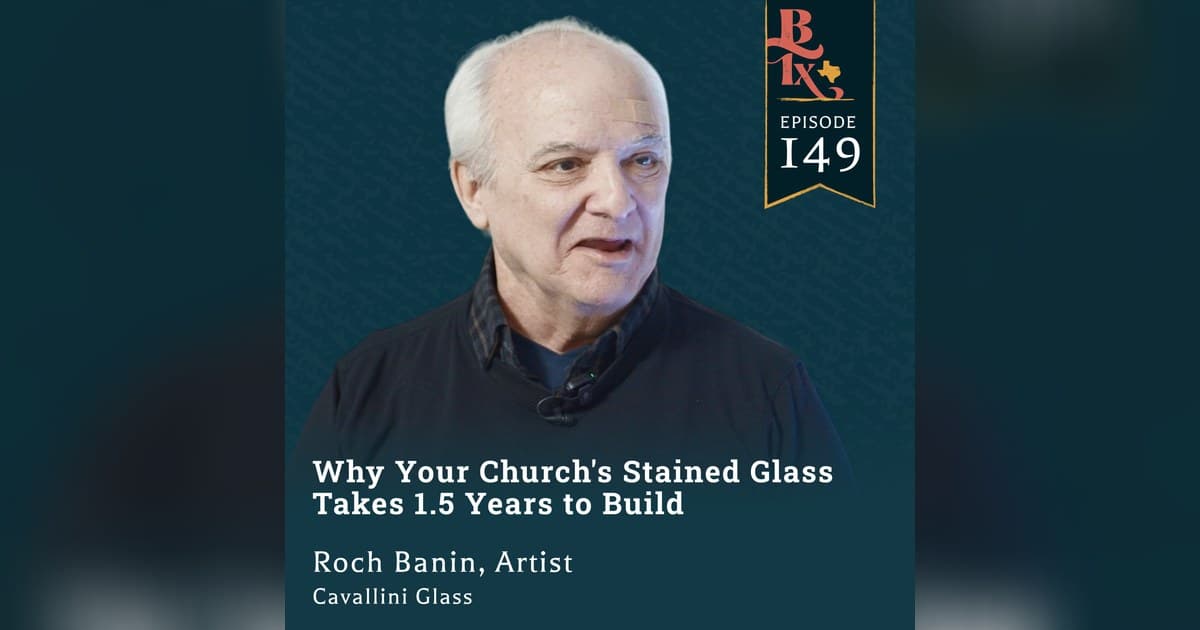
The second episode of 'The Cavallini Legacy,' hosted by Justin McKenzie on 'The Building Texas Show,' offers an inside look at the 18-month process behind handcrafted stained glass windows and the irreplaceable value of human artistry in an age of artificial intelligence. Published May 27, 2026, the conversation arrives as houses of worship rebuild and restore amid rising interest in artisan craftsmanship.
The episode unpacks why an authentic stained glass commission can take up to 18 months to complete, and why no AI template can replicate the result. The discussion covers a wide range of subjects pulled directly from inside the Cavallini & Co. studio, a Texas-based stained glass house that has designed and installed handcrafted, architect-grade sacred art for congregations across Texas and beyond for more than 70 years.
Key topics include how themes are developed in dialogue with parishioners, often tracing Old Testament to New Testament narratives from Creation and Moses to the Nativity, Resurrection, and Ascension. The hidden structural engineering inside every panel is also explored, including the rebars that transfer weight to the frame and prevent the glass and lead from bowing under its own weight.
A central story in the episode is the 18-year journey of Munich-style windows salvaged from St. Mary's Catholic Church in Port Arthur after Hurricane Rita, now finding a new home at Our Lady of the Holy Rosary in Houston. The episode's centerpiece is the Our Lady of the Holy Rosary commission. After a natural gas explosion destroyed the original Houston church and claimed a parishioner's life, the congregation began building anew. Cavallini had purchased the Mysteries of the Rosary windows from the Diocese of Beaumont 18 years earlier, stored them, and recognized their fit for the new sacred space. Adrian Cavallini sent photographs to a committee member who, in the elder Cavallini's words, 'just fell in love with them.' The studio is now creating the Luminous Mysteries to blend with the existing set, completing a cycle that began with Hurricane Rita and now spans generations of Texas congregations.
Throughout the episode, Mr. Cavallini and his son Adrian make the case that patience and craft are inseparable from sacred art. Reflecting on the modern pace of design, McKenzie observes: 'Employees coming in here working on a project that might take a year and a half to complete because it is detail-oriented or it's 50,000 square feet of mosaic that takes detail and time. It's not AI is going to create it in 30 seconds and here it is. And I worry for our economy and our workforce on how do we bring that patience back to something as meaningful as the work you're doing.'
For business leaders and technology enthusiasts, the episode underscores a growing tension between efficiency-driven AI and the enduring value of handcrafted quality. As industries increasingly turn to AI for speed, Cavallini's 18-month timeline stands as a counterpoint, suggesting that some products—particularly those tied to cultural or spiritual significance—demand human touch and time. The implications extend beyond stained glass: sectors from architecture to luxury goods may need to balance technological acceleration with the premium placed on authentic, labor-intensive craftsmanship.
Listeners can access Episode 2 of 'The Cavallini Legacy' wherever podcasts are heard. For more on the studio's work, visit Cavallini & Co..
