

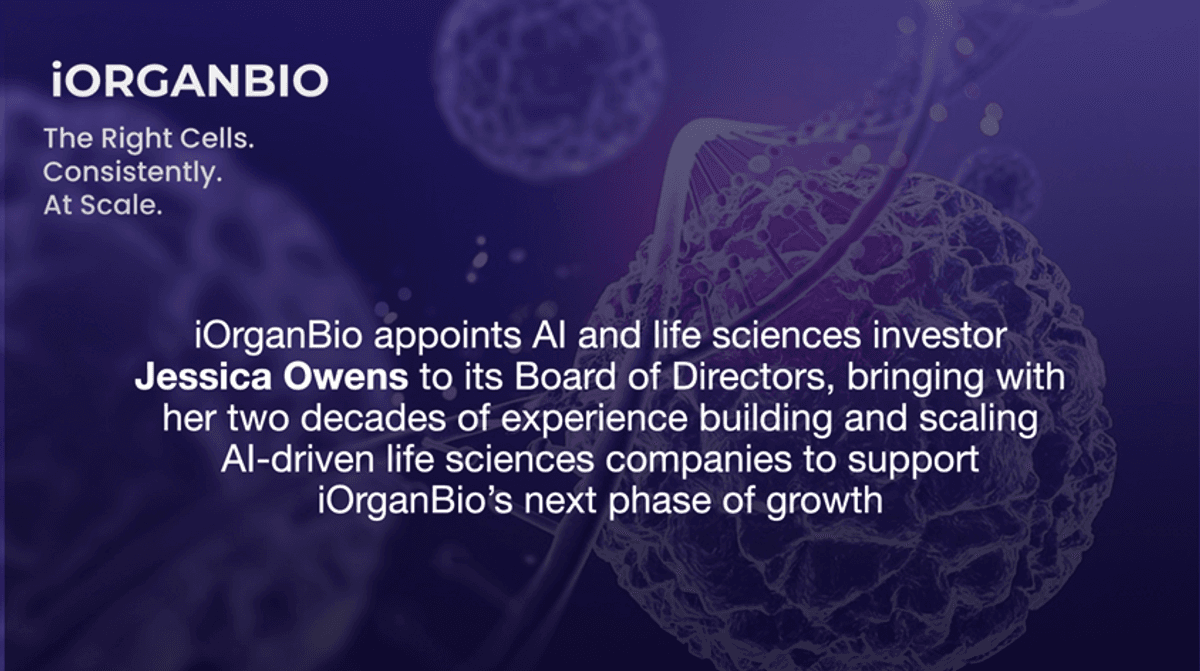
CHAPEL HILL, N.C. — iOrganBio, a company redefining human cell engineering and production for research and therapeutic applications, announced the appointment of Jessica Owens to its Board of Directors. Owens brings over 20 years of experience in company building and investing at the intersection of life sciences, health technology, and artificial intelligence.
Owens co-founded GRAIL, a healthcare company that raised over $1 billion and formed partnerships with Bristol Myers Squibb, Merck, and Johnson & Johnson. She also serves as co-founder and General Partner at Initiate Ventures. Her expertise will be instrumental as iOrganBio scales its CellForge platform, expands partnerships, and advances AI-driven cell manufacturing to improve predictability and scalability from model development to cell therapies.
CellForge is iOrganBio's AI-powered platform for consistent, scalable, and intelligent manufacturing of cells and organoids for in vitro modeling and cell therapies. By applying engineering precision to biology, CellForge uses AI and automation to guide cell development and make real-time adjustments aligned with defined biological profiles. The platform is underpinned by iOrganBio's functional human CellAtlas, a comprehensive reference built from single-cell and multi-omics data that provides digital blueprints for each cell type.
This appointment comes as iOrganBio aims to accelerate the adoption of its platform in drug development, disease modeling, and regenerative medicine. The company's focus on FDA-aligned New Approach Methodologies (NAMs) positions it to potentially reduce reliance on animal testing and improve the predictability of preclinical studies. For industry leaders, the advancement of AI-driven cell manufacturing could lead to more efficient and cost-effective production of cell therapies, as well as more reliable organoid models for research.
Jessica Owens stated that she is excited to join iOrganBio's board and help the company scale its technology. The company believes her counsel will be invaluable as it expands its partnerships and continues to innovate in AI-driven cell manufacturing. iOrganBio is based at BioLabs in Chapel Hill, North Carolina, and more information can be found at iOrgan.Bio.
The implications of this appointment extend beyond iOrganBio. As AI continues to integrate with life sciences, the ability to reliably produce human cells at scale could transform drug development pipelines and personalized medicine. With Owens' track record of building and scaling companies, iOrganBio is well-positioned to capitalize on the growing demand for advanced cell models and therapies.
