

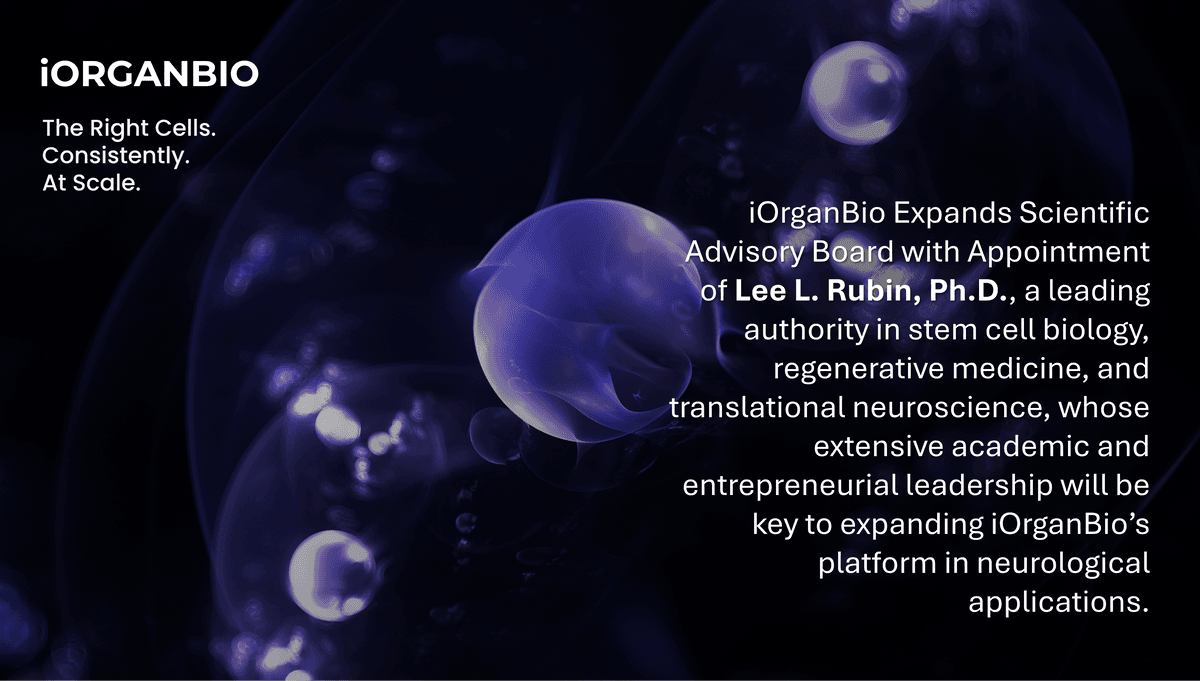
iOrganBio, a company specializing in intelligent cell manufacturing, announced today the appointment of Lee L. Rubin, Ph.D., to its Scientific Advisory Board. Dr. Rubin is a prominent figure in stem cell biology, regenerative medicine, and translational neuroscience, currently serving as Co-Director and Principal Faculty of the Harvard Stem Cell Institute and Professor in Harvard’s Department of Stem Cell and Regenerative Biology.
Dr. Rubin’s research has significantly advanced the understanding of neurodegenerative diseases and contributed to the development of multiple therapeutic candidates. His work spans blood-brain barrier biology, neural stem cell differentiation, disease modeling using patient-derived induced pluripotent stem cells, and the discovery of therapeutic candidates for disorders including Parkinson’s disease, amyotrophic lateral sclerosis (ALS), and spinal muscular atrophy (SMA).
This appointment is expected to bolster iOrganBio’s capabilities in neurological applications. The company’s CellForge platform combines AI prediction, biological sensing, and automated 3D incubation to engineer human cells and organoids with greater precision and consistency. This enables scalable production for disease modeling, drug discovery, and cell therapy development.
“We are thrilled to welcome Dr. Rubin to our Scientific Advisory Board,” said a spokesperson for iOrganBio. “His deep expertise in stem cell biology and neuroscience will be invaluable as we expand our platform into new therapeutic areas.”
For business and technology leaders, this move signals iOrganBio’s strategic focus on neurological diseases, a major area of unmet medical need. The integration of Dr. Rubin’s knowledge could accelerate the development of more accurate disease models and therapies, potentially reducing the time and cost of drug development. The CellForge platform’s AI-driven approach to cell manufacturing also represents a shift toward more consistent and scalable production methods, which could impact the broader biotech and pharmaceutical industries.
iOrganBio’s technology is particularly relevant for FDA-aligned New Approach Methodologies (NAMs), which aim to reduce reliance on animal testing and improve predictivity in drug development. By enabling more precise human cell models, the company’s platform could help researchers better understand disease mechanisms and screen drug candidates earlier in the pipeline.
For more information about iOrganBio and its CellForge platform, visit iOrgan.Bio.
