

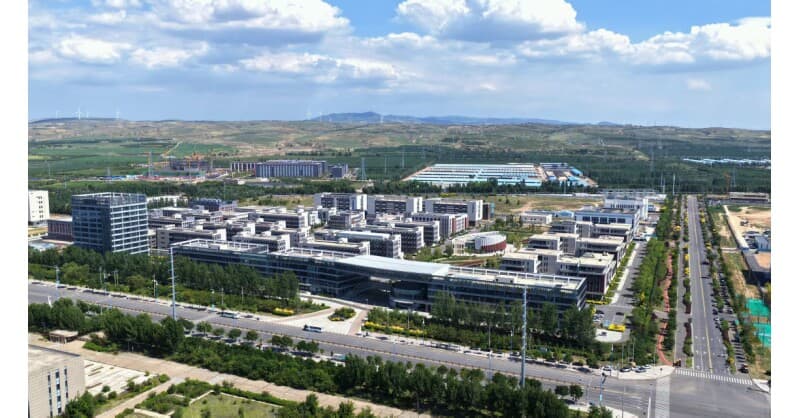
As artificial intelligence reshapes industries, the demand for computing power has skyrocketed, and with it, the need for efficient, sustainable data centers. At the fourth annual Green Computing Power (Artificial Intelligence) Conference held on August 22, 2026, in Hohhot, Inner Mongolia, industry leaders gathered to unveil strategies that could redefine how AI is powered. The conference showcased the region's innovative approach to marrying green energy with high-performance computing, a model that may hold the key to the future of AI infrastructure.
Hohhot's appeal as a data center hub is no accident. With an average annual temperature of just 7°C and over 200 days suitable for direct outdoor air cooling, the city offers natural advantages that slash cooling costs by more than 20%. Electricity prices around 0.36 yuan per kilowatt-hour mean a large-scale GPU cluster can save approximately 50 million yuan annually compared to other regions. Currently, Hohhot's total computing capacity reaches 150,000 P, with over 80% of its electricity coming from green sources. This combination of cost and sustainability has attracted major players, including ByteDance and Cambricon, which signed agreements worth tens of billions of yuan for green intelligent computing centers and token factories.
The core challenge, however, lies in the intermittent nature of wind and solar power. AI workloads require 24/7 uptime, but renewable energy is subject to weather variability. Hohhot's solution is an innovative 'computing-electricity synergy' mechanism. China Huadian Corporation has built a 360,000-kilowatt integrated wind-solar-storage power station, featuring 300,000 kilowatts of wind, 60,000 kilowatts of photovoltaic, and four-hour energy storage. A collaborative control platform collects data on wind output, solar irradiance, storage status, and computing load at millisecond intervals to dynamically allocate power. When green energy is abundant, storage systems charge and delay-tolerant tasks are prioritized; when it's scarce, storage discharges, the grid supplements, and flexible tasks are deferred. This bidirectional interaction transforms power generation and consumption from a one-way street into a responsive system.
The efficiency gains are tangible. The Hohhot data center operated by China Mobile has improved its Power Usage Effectiveness (PUE) from 1.315 to 1.209 by recovering waste heat from nearby power plants for cooling. This change saves 560,000 kilowatt-hours annually since the B02 machine hall began operations, with projections of 10 million kilowatt-hours and 150,000 tons of water saved annually when both halls are fully operational. Given that electricity costs can account for over 70% of a data center's operating expenses—as evidenced by the 290 million yuan electricity bill at the Hohhot Intelligent Computing Center in 2025—these innovations are critical.
The impact extends beyond Hohhot. China's 'East Data West Computing' project, which redirects high computing demand from eastern regions to resource-rich western areas, positions Hohhot as a strategic node. The city now hosts 62 computing center projects, including data centers for China's three major telecom operators, 16 financial institutions, and computing nodes from Huawei, ByteDance, and Kuaishou. Upstream, 45 local manufacturers produce servers, cabinets, and sensors, creating a robust ecosystem. According to the recently published three-year action plan, Hohhot aims to establish 10 token factories capable of producing 20 trillion tokens daily by 2028, enabling customers to procure not just cabinets and bandwidth but tailored intelligent services.
For business leaders, this development signals a shift in how AI infrastructure is deployed. The 'computing-electricity synergy' model could serve as a blueprint for other regions seeking to balance sustainability with the immense power demands of AI. As the world races to build AI capabilities, the ability to harness green energy efficiently will become a competitive advantage. Hohhot's success demonstrates that the future of AI lies not only in algorithmic breakthroughs but also in the physical infrastructure that powers them.
