

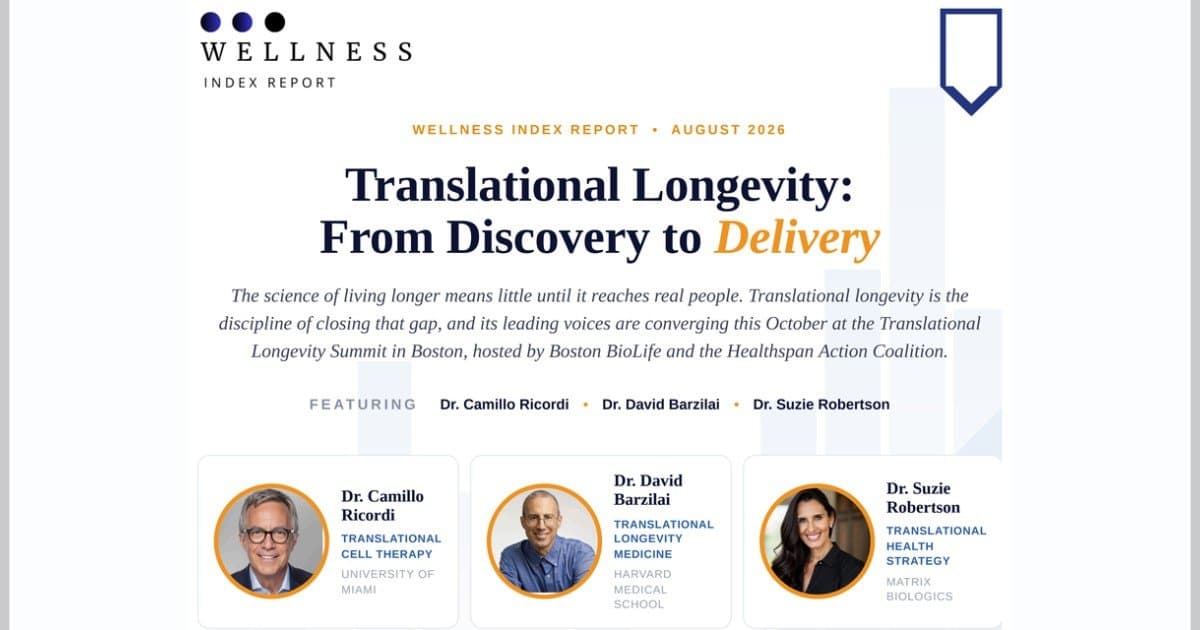
The August Wellness Index Report, published by Wellness Eternal, zeroes in on the critical yet often overlooked phase of longevity science: translational longevity. This discipline bridges the gap between laboratory discoveries and real-world patient care. According to the report, the science of living longer is meaningless unless it reaches actual people, and this translational work is where longevity is truly won.
The report identifies three key signals driving the field forward. First, cell science is moving from proof of concept to real clinical delivery. Decades of research in transplantation and cell therapy are transitioning from specialized centers into broader medical practice, aiming to reverse rather than merely manage the drivers of disease and aging. Second, evidence is becoming the crucial bridge from research to practice. As longevity claims proliferate, the ability to distinguish proven science from promising hype is increasingly valued, making evidence-based guidance essential for clinicians, executives, and policymakers. Third, clinical strategy and systems are proving vital to scaling care. Even the most effective therapies fail if they cannot be delivered safely and consistently, highlighting the need for operational rigor and smarter care models.
The report features three experts who embody these signals. Dr. Camillo Ricordi from the University of Miami anchors the first signal with his work in translational cell therapy. Dr. David Barzilai, a Harvard Medical School lecturer and longevity medicine physician, represents the evidence-based approach, known for making complex science accessible to decision-makers. Dr. Suzie Robertson of Matrix Biologics, a clinical pharmacist and healthcare strategist, exemplifies the strategic and operational expertise needed to scale care delivery.
These thought leaders will converge at the Translational Longevity Summit in Boston from October 7 to 11, hosted by Joseph Krieger of Boston BioLife and Bernard Siegel of the Healthspan Action Coalition. The summit aims to unite discovery, clinical practice, and community impact, reflecting the ethos that the future of longevity is not just discovered but delivered.
The report's findings carry significant implications for the industry. For healthcare executives and policymakers, the emphasis on translational longevity signals a shift toward practical, scalable solutions over theoretical breakthroughs. It underscores the importance of investing in systems that can efficiently and safely bring new therapies to patients. Moreover, the focus on evidence-based practice challenges the market to demand rigorous validation, potentially reshaping how longevity products and services are evaluated and adopted.
For the broader world, the report suggests that the longevity sector is maturing from hype to tangible outcomes. As the Wellness Index Report's four-step verification process—expert nomination, patient feedback, clinical review, and performance tracking—becomes more influential, it could standardize quality in the industry, protecting consumers and guiding investors.
The Translational Longevity Summit itself promises to be a pivotal event, potentially accelerating collaborations and setting the agenda for the next phase of longevity science. As Lindsay O'Neill-O'Keefe, founder of Wellness Eternal, aptly stated, "Discovery is only half the job. Delivery is the rest."
